


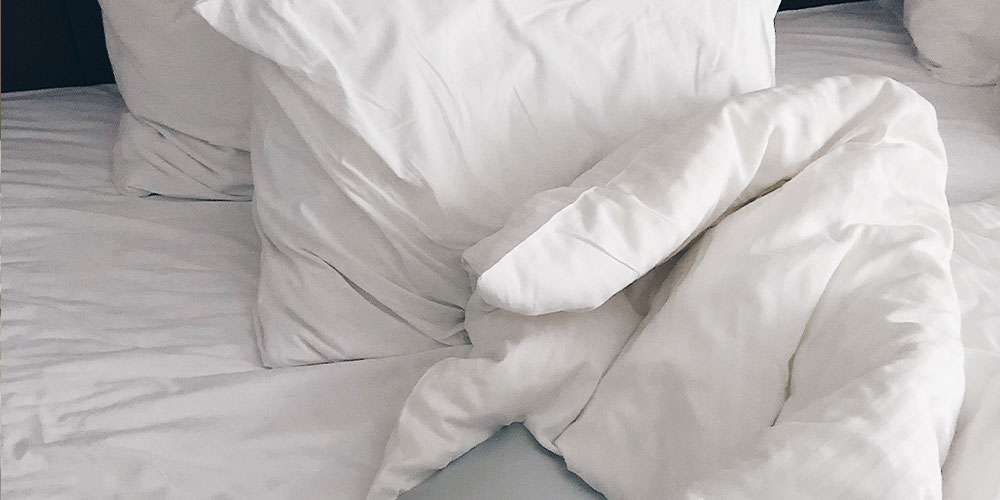
Over time, your bed duvet, whether natural down or synthetic, risks being damaged if not cared for on a daily basis. Over the years, it can lose its key qualities such as thermal regulation, its insulating power or its loft. Properly caring for your bed linen can not only help you extend its lifespan, but also have a positive impact on the quality of your sleep. A well-maintained duvet reduces the risk of dust mites, dust or mould developing, and therefore potential allergies. But what are the tips for maintaining it well and keeping its properties for as long as possible? We will therefore look at the best tips for caring for your duvet on a daily basis and extending its lifespan; just a few gestures a day are enough to keep your linen in good condition and prevent it from deteriorating too quickly.
Understanding your feather and down duvet
First and foremost, it is important to make a distinction between a duvet with a natural filling and a duvet with synthetic fibres. While synthetic duvets are easier to care for, natural down duvets are often more expensive and require particular care, as their filling is quite delicate and can be damaged if not properly maintained. The lifespan of a duvet depends primarily on two factors: the quality of its fabrics and how it is cared for. For this reason, it is important to find out about the washing instructions for a duvet, either through its labels or by reading all the advice you will find in our articles.
Regular washing
Even if your bed linen is covered by duvet covers, it is better to put it in the machine from time to time to eliminate all traces of moisture and/or microbes. For natural down duvets, it is recommended to rely on a professional who will be more familiar with the instructions to follow and will help you avoid damaging your duvet with the wrong programme. In general, for natural down duvets, dry cleaning is advised. It is perfectly possible, however, to wash your duvet at home with your usual machine. Naturally, to avoid damaging the duvet, it is better to refer to its label and follow a few important guidelines carefully. For example, with our Pyrenex duvets, we recommend washing them one to two times per year in a drum of at least 5 kg with a 40°C programme each time. Generally speaking, a feather or down duvet will be more delicate than a synthetic duvet, as its filling is more fragile and can deteriorate quickly. For these reasons, it is advisable to use a gentle wash and spin cycle. Ideally, it is better to use a liquid detergent, which will be easier to dissolve than a powder detergent. Upon your purchase, Pyrenex provides you with 5 doses of soap to use for your next 5 washes in order to guarantee the same loft and comfort as when you made your purchase.
Gentle drying
The drying phase of your duvet is equally important and must not be neglected, as a poorly dried duvet can lead to the proliferation of bacteria. If the weather permits, leave your duvet to dry in full sunlight: the sun will naturally disinfect your product from all types of bacteria. On the other hand, if you do not have the possibility of drying your duvet in the open air, use a tumble dryer, but be careful to use a short, gentle programme for delicate laundry.
The right daily habits to adopt
To avoid moisture build-up in your duvet, remember to air your bedroom every day. Your duvet, like your mattress, your sheets or your bed base, needs air to circulate between its fibres in order to release perspiration residues and eliminate the moisture accumulated during the night, making way for fresh, healthier air.
It is also advisable to air your bedroom as early as possible in the morning, when the air is purer and less polluted. Furthermore, changing the sheets and the cover of your duvet every week is ideal for maintaining good hygiene of your bedding. Between sheet changes, you can take the opportunity to leave your duvet in the open air to eliminate all traces of moisture. A well-ventilated bedroom reduces the proliferation of dust mites, the main cause of allergies in humans. Another tip for keeping your duvet in good condition is to shake it every morning. By shaking your down duvet, its loft will return to its original shape and the down will settle back into place. You will thus have a better chance of eliminating traces of moisture. Paying attention to the temperature of your bedroom can also help. The recommended temperature for your bedroom is between 15°C and 18°C; beyond these temperatures, not only will you have a poor sleep experience, but you will tend to perspire more easily, thereby encouraging the build-up of moisture on your bedding.
Storage advice
The last step of our care guide consists of describing the storage method once the season is over and it is time to put away your duvet. First of all, it is best to avoid compressing your duvet when storing it. This could break the feathers and thus cause it to lose its loft.
Secondly, choose your storage location carefully — it must absolutely be sheltered from moisture and light. This environment will prevent your duvet from developing unpleasant odours and, on the contrary, from encouraging the formation of mould. Therefore, avoid any plastic packaging which, through a condensation effect, could lead to the formation of mould on your duvet. Instead, opt for covers made from natural fibres such as cotton or satin.
Here are a few tips to extend the lifespan of your duvet. If, despite all these tips, you realise it may be time to replace your duvet, visit our website to find what you are looking for.


